

If you’ve ever asked “how much should small business marketing cost?” and walked away from Google more confused than when you started — you’re not alone. Search results bounce between “$500/month is plenty” and “$10,000/month minimum or don’t bother.” Neither answer is helpful, and neither one is true for your business. This guide cuts through the noise with real 2026 pricing, what each tier of marketing investment actually buys you, and how to figure out the right number for where your business is right now.
Table of Contents
What Does the Average Small Business Marketing Cost Look Like?
Let’s start with the benchmarks the data actually supports.
The U.S. Small Business Administration recommends most small businesses spend 7–8% of gross revenue on marketing if they’re in growth mode. The exact number flexes based on industry, business age, and growth goals — but that 7–8% range is a reasonable starting line.
Here’s what that looks like at different revenue levels:
- $200,000/year revenue → ~$14,000–$16,000/year on marketing ($1,200–$1,300/month)
- $500,000/year revenue → ~$35,000–$40,000/year on marketing ($2,900–$3,300/month)
- $1M/year revenue → ~$70,000–$80,000/year on marketing ($5,800–$6,600/month)
- $2M/year revenue → ~$140,000–$160,000/year on marketing ($11,600–$13,300/month)
If your business is younger than 5 years or actively trying to grow, lean toward the higher end. If you’re stable and just maintaining, the lower end works. If your revenue isn’t there yet but you need to grow it, the percentage rule doesn’t apply cleanly — you may need to invest higher than 8% temporarily to build momentum.
What Drives Small Business Marketing Cost Up or Down?
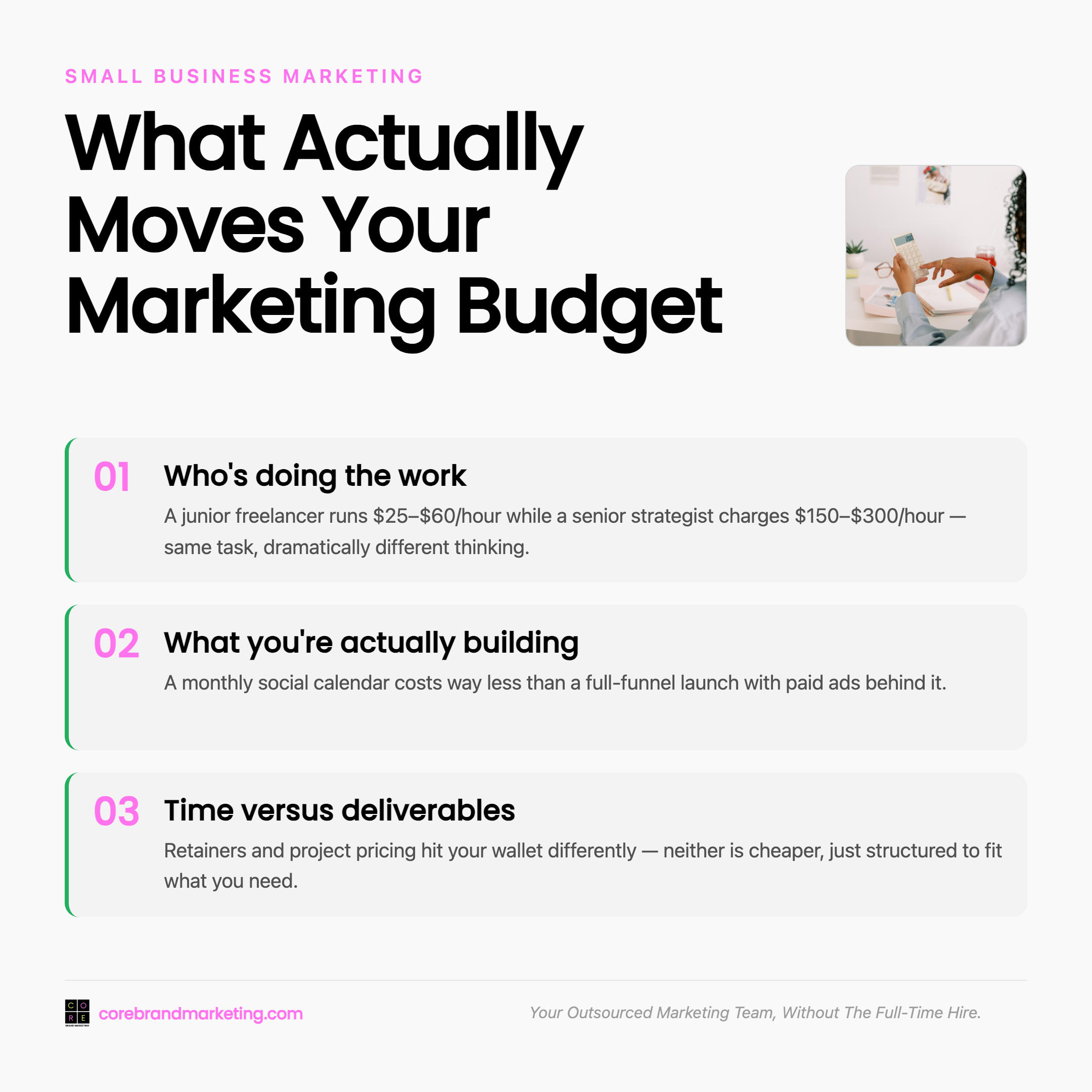
Three factors move the needle the most:
- Who’s doing the work. A junior freelancer charges $25–$60/hour. A senior agency strategist charges $150–$300/hour. Same task, very different output.
- What you’re trying to accomplish. A monthly social media schedule costs less than a full-funnel launch with paid ads.
- Whether you’re paying for time or deliverables. Retainers and project pricing produce different invoices — one isn’t categorically cheaper, just structured differently.
Understanding these levers is how you stop comparing apples to oranges when you’re shopping for help.
What Does Each Tier of Small Business Marketing Cost Actually Get You?
Here’s an honest breakdown of what your monthly marketing investment buys at different price points in 2026.
$0–$500/month: DIY with light tools
What you get: Canva Pro, an email platform like MailerLite or Brevo, basic social scheduling, and your own time. No outside help.
Best for: Pre-revenue side projects, hobbyists, or solo founders building from zero. This tier works only if you have time and the willingness to learn marketing as a skill.
What you don’t get: Strategy. Consistency at scale. Anyone watching the data. Anyone making sure the work actually moves the business forward.
$500–$1,500/month: VA or junior freelancer help
What you get: Someone to schedule social posts, design simple graphics, format your blog posts, send your weekly email. Execution-level support.
Best for: Solopreneurs who already have a strategy in their head and just need hands to execute it consistently.
What you don’t get: Strategic thinking. SEO depth. Funnel building. Anyone catching what’s broken before it costs you.
$1,500–$3,500/month: Day-rate or fractional marketing partner
What you get: A senior-level marketer working on your business 1–3 focused days per month. Strategy, execution, audits, content, SEO, email — under one roof. Real marketing partnership without the agency overhead. (Not sure which structure fits you? Here’s the full breakdown of marketing retainer vs. day rate.)
Best for: Small businesses with $200K–$1M in revenue who are ready to grow but not ready to hire a full-time marketing manager. This is the sweet spot for most CORE clients.
What you don’t get: Daily presence. Heavy ad spend management. Multi-person specialty teams.
$3,500–$8,000/month: Boutique agency or 4-day-a-month fractional
What you get: A small dedicated team or a 4-day fractional partner running real marketing operations on your business. Strategy, execution, paid ads, SEO, content, email, and reporting. Closest thing to having a marketing team.
Best for: Businesses doing $750K+ in revenue with clear growth goals and the cash flow to invest aggressively.
What you don’t get: Enterprise-level analytics tooling. A 10-person team. C-suite consulting.
$8,000+/month: Full-service agency or in-house team
What you get: A multi-person team with specialists across paid media, SEO, content, design, and strategy. Heavier reporting cadence, more sophisticated tools, deeper specialization.
Best for: Established businesses doing $2M+ in revenue with complex marketing operations.
How to Figure Out the Right Small Business Marketing Cost for You
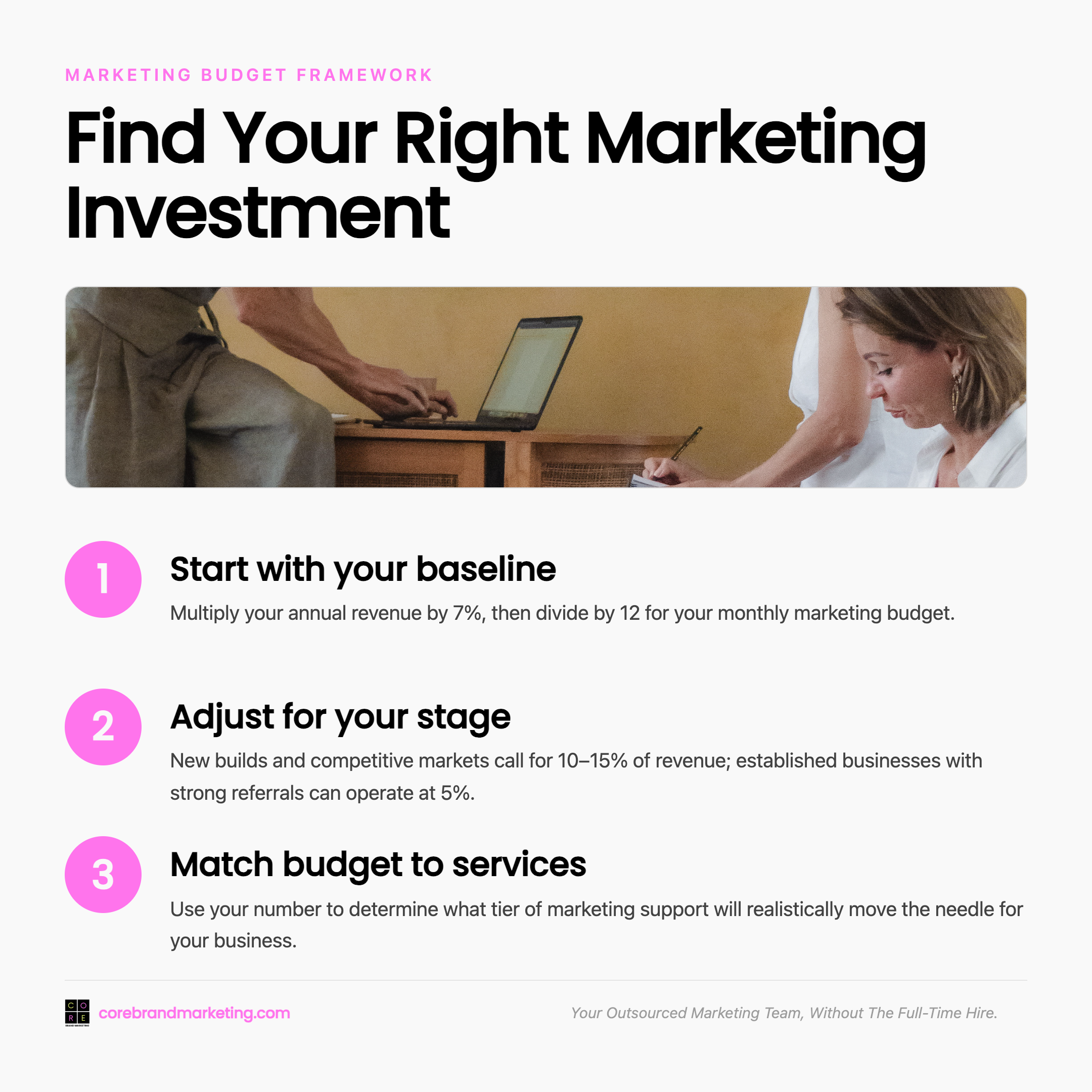
Here’s the framework I walk every prospective CORE client through:
- Take your current annual revenue. Multiply by 7%. That’s your annual marketing baseline.
- Divide by 12. That’s your monthly baseline.
- Adjust up if you’re growing. New businesses, businesses in launch mode, or businesses in competitive industries should plan for 10–15% of revenue.
- Adjust down if you’re stable. Mature businesses with strong word-of-mouth can sometimes operate at 5%.
- Match the budget to the right service tier. Use the breakdown above to figure out where your number lands and what kind of help it can realistically buy.
Step 5 is where most small business owners get stuck. They have $2,500/month earmarked for marketing — but they don’t know whether that should buy a junior freelancer, a fractional marketer, or a small agency.
The honest answer for most $2,500/month budgets is: a fractional marketing partner gets you the most value, because you’re getting senior-level skill (strategy + execution) without paying agency overhead.
A Simpler Way to Think About Marketing Cost
Here’s how I price CORE Days, the day-rate model I built specifically for small businesses figuring out the right marketing investment:
- 1 CORE Day per month — $1,000: Best for solopreneurs needing one focused priority a month
- 2 CORE Days per month — $2,000: Building real content and execution rhythm
- 3 CORE Days per month — $3,000: Strategy and execution working in lockstep
- 4 CORE Days per month — $4,000: Your full marketing arm, for businesses ready to scale
Each CORE Day is 5 focused hours of expert marketing work — strategy, copy, SEO, funnels, email, social, audits, whatever this month calls for. No locked-in scope. Month-to-month. Scale up or down as your business needs shift.
Compared to traditional retainers in the $2,500–$5,000/month range, CORE Days delivers the same caliber of work with significantly more flexibility — and a much lower entry point if you want to start with a single day before scaling up.
See the full CORE Days breakdown →
Frequently Asked Questions
What is the average marketing budget for a small business in 2026?
Most small businesses spend 7–8% of gross revenue on marketing in 2026. For a $500,000 business, that’s roughly $2,900–$3,300 per month. Younger or growing businesses often need to invest 10–15% to build momentum, while mature businesses can sometimes operate at 5%.
Can I run small business marketing for less than $1,000 a month?
Yes, but with significant trade-offs. At under $1,000/month, you’re typically paying for tools and a junior freelancer or VA — execution help only, no strategy. This works for very early-stage businesses or solopreneurs with a clear plan, but it’s rarely enough to drive real growth on its own.
How much does a fractional marketing service cost?
Fractional marketing services typically range from $1,000 to $5,000 per month, depending on how many days or hours you book. Day-rate models like CORE Days start at $1,000 for one focused day per month and scale up to $4,000 for four days a month. This gives small businesses senior-level marketing support without the cost of a full-time hire.
Is a marketing agency or fractional marketer cheaper for small business?
Fractional marketers are usually more cost-effective for small businesses because you skip agency overhead. A traditional agency retainer starts around $2,500–$5,000/month minimum, while a fractional day-rate model lets you start at $1,000/month and scale as needed. The work quality is comparable when the fractional marketer is senior-level.
How do I know if I’m spending enough on small business marketing?
Two signs you’re under-investing: marketing keeps falling off your to-do list because you’re doing it alone, and your growth has plateaued or declined. Two signs you’re over-investing: you can’t track what’s working, or your marketing spend is consistently above 15% of revenue without proportional growth. If you want an outside read on whether your spend is actually working, The CORE Marketing Audit scores your SEO and social presence and shows you where the money is leaking.
The Bottom Line on Small Business Marketing Cost
There’s no single right answer to how much small business marketing should cost — but there is a right answer for your business. Start with the 7–8% rule, adjust based on your growth goals, and match the resulting budget to the service tier that gets you the most leverage. For most small businesses, that lands somewhere between a fractional marketing partner and a small agency — both of which produce far more value than DIY plus a junior freelancer ever will.
If you’d rather skip the math and start with a single day of expert marketing help, CORE Days is built for exactly that.
Ready to find out what one focused day of marketing help could do for your business? Apply to work with us →




0 Comments