

You’ve decided it’s time to hire marketing help. You’ve outgrown DIY. You’re tired of watching your to-do list pile up while marketing — the actual engine of new business — keeps slipping to the bottom. So you start researching, and you immediately hit a wall: do you sign a marketing retainer vs day rate arrangement? Both promise expert help. Both have a price tag. And almost no one explains, in plain language, which one actually fits a small business in 2026.
This guide does. By the end, you’ll know exactly how the two pricing models work, the honest pros and cons of each, and a third option most small business owners don’t even know exists.
Table of Contents
What Is a Marketing Retainer?
A marketing retainer is a recurring monthly agreement where you pay a fixed amount in exchange for a defined scope of work — usually a specific list of deliverables. Think “4 blog posts, 12 social posts, and 1 email per month.” The retainer is the backbone of how most marketing agencies have priced themselves for the last 20 years.
How retainers typically work:
- You sign a 3-, 6-, or 12-month contract
- You pay a flat fee each month (commonly $1,500 to $10,000+ for small businesses)
- The agency delivers a fixed scope of work each month
- Adjustments to scope require renegotiation or “add-on” pricing
- Some retainers include a set number of “hours” instead of deliverables
The pros of a marketing retainer
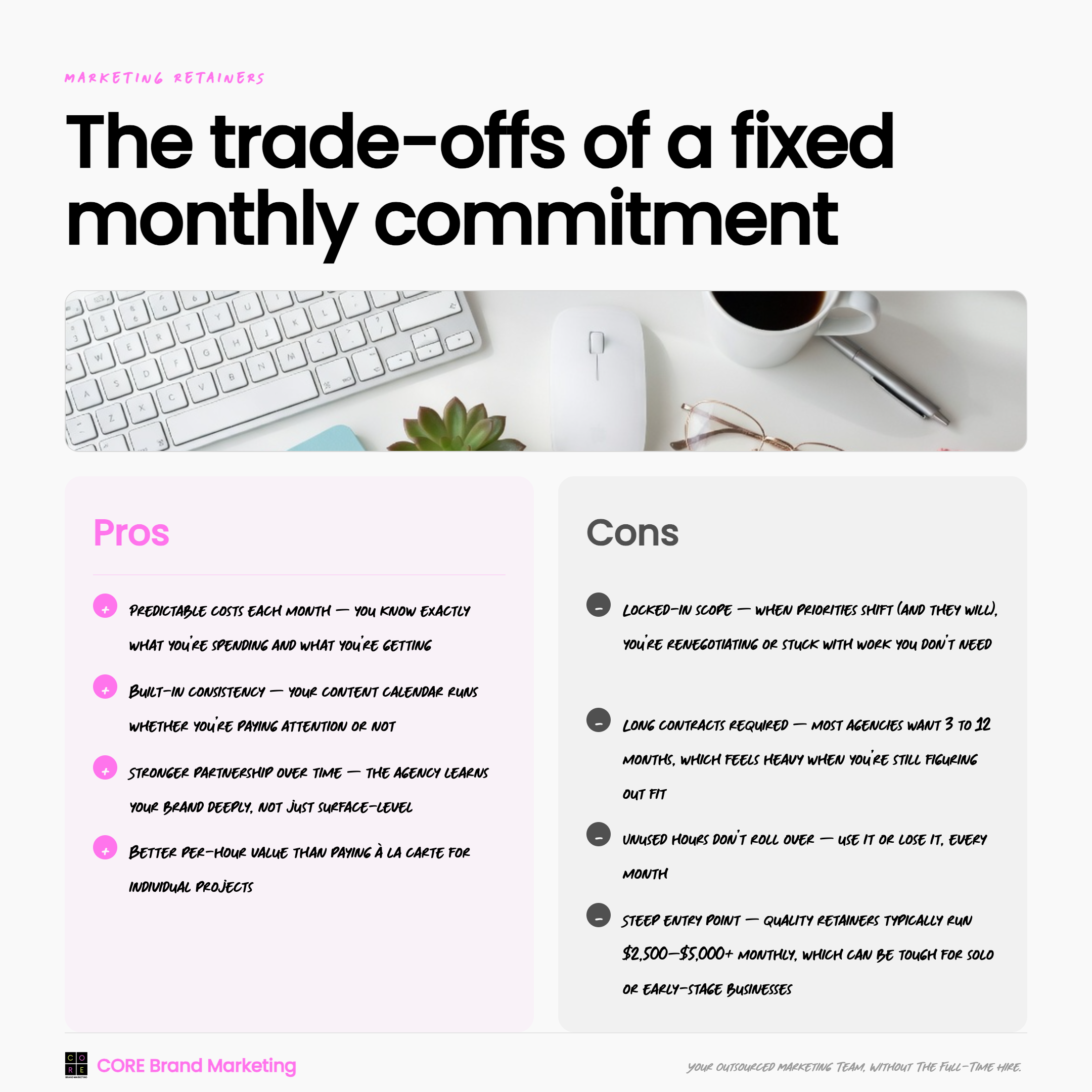
- Predictability — same price, same deliverables, every month
- Built-in consistency — content goes out on schedule whether you’re paying attention or not
- Stronger relationships — over time, the agency learns your brand deeply
- Often better per-hour rates than à la carte project pricing
The cons of a marketing retainer
- Locked-in scope — if your priorities shift mid-month (and they will), you’re either stuck with deliverables you don’t need or renegotiating scope
- Long contracts — most agencies require 3- to 12-month commitments, which feels heavy when you’re not 100% sure about the fit yet
- “Use it or lose it” pressure — unused hours rarely roll over
- Expensive entry point — most quality retainers start around $2,500–$5,000/month, which is steep for a solo or growing business
What Is a Marketing Day Rate?
A marketing day rate flips the model. Instead of paying for deliverables, you pay for time — a focused day (or block of hours) of expert marketing work, used however your business needs it that month.
How day rates typically work:
- You buy a single day or a set of days at a flat rate (commonly $750 to $2,500 per day)
- Each “day” represents a focused block of hours (usually 5–8)
- You direct the priority — strategy, execution, audits, whatever moves the needle
- Most arrangements are month-to-month with no long contract
- You can scale up or down based on what your business needs
The pros of a marketing day rate
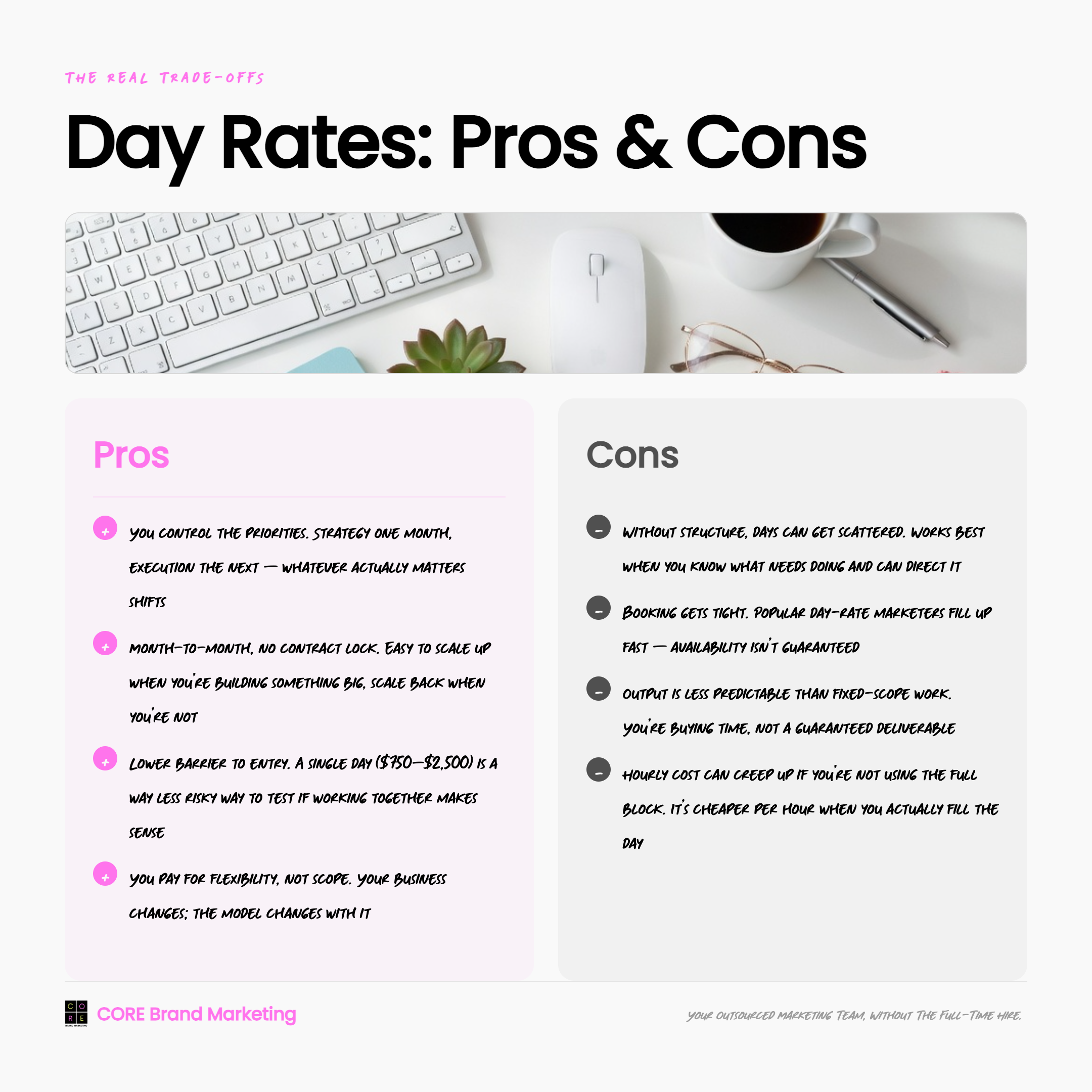
- Total flexibility — use the day for whatever this month actually requires
- No locked-in scope — your priorities can shift; the day rate model bends with you
- Lower commitment — most are month-to-month with simple cancellation terms
- Easier entry point — buying a single day is a much lower-risk way to test working with someone
- Scales with you — buy 1 day this month, 3 the next, depending on what you’re building
The cons of a marketing day rate
- Less predictable output — without a fixed scope, less-organized clients can waste days
- Requires you to direct priorities — works best when you have a sense of what needs doing
- Capacity constraints — popular day-rate marketers book up fast
- Can be more expensive per hour if you’re heavily under-using the time
Marketing Retainer vs. Day Rate: The Real Differences
Here’s the honest, side-by-side comparison most agencies won’t show you:
| Factor | Traditional Retainer | Marketing Day Rate |
|---|---|---|
| Pricing model | Pay for deliverables | Pay for time |
| Flexibility | Low — fixed scope | High — direct the priority |
| Commitment | 3–12 month contract | Month-to-month |
| Entry investment | $2,500–$5,000+/mo typical | $750–$2,500/day |
| Scope shifts | Requires renegotiation | Built in |
| Best for | Stable monthly needs | Shifting priorities |
| Worst for | Businesses still figuring out what they need | Disorganized clients |
The deeper truth: retainers are built around the agency’s convenience. Predictable revenue, predictable workload. Day rates are built around the client’s reality. Small business priorities shift constantly — a launch this month, a website fix next month, an SEO audit the month after that. The retainer model can’t bend that way without friction.
Which One Is Right for Your Business?
Here’s a simple decision framework:
Choose a marketing retainer if:
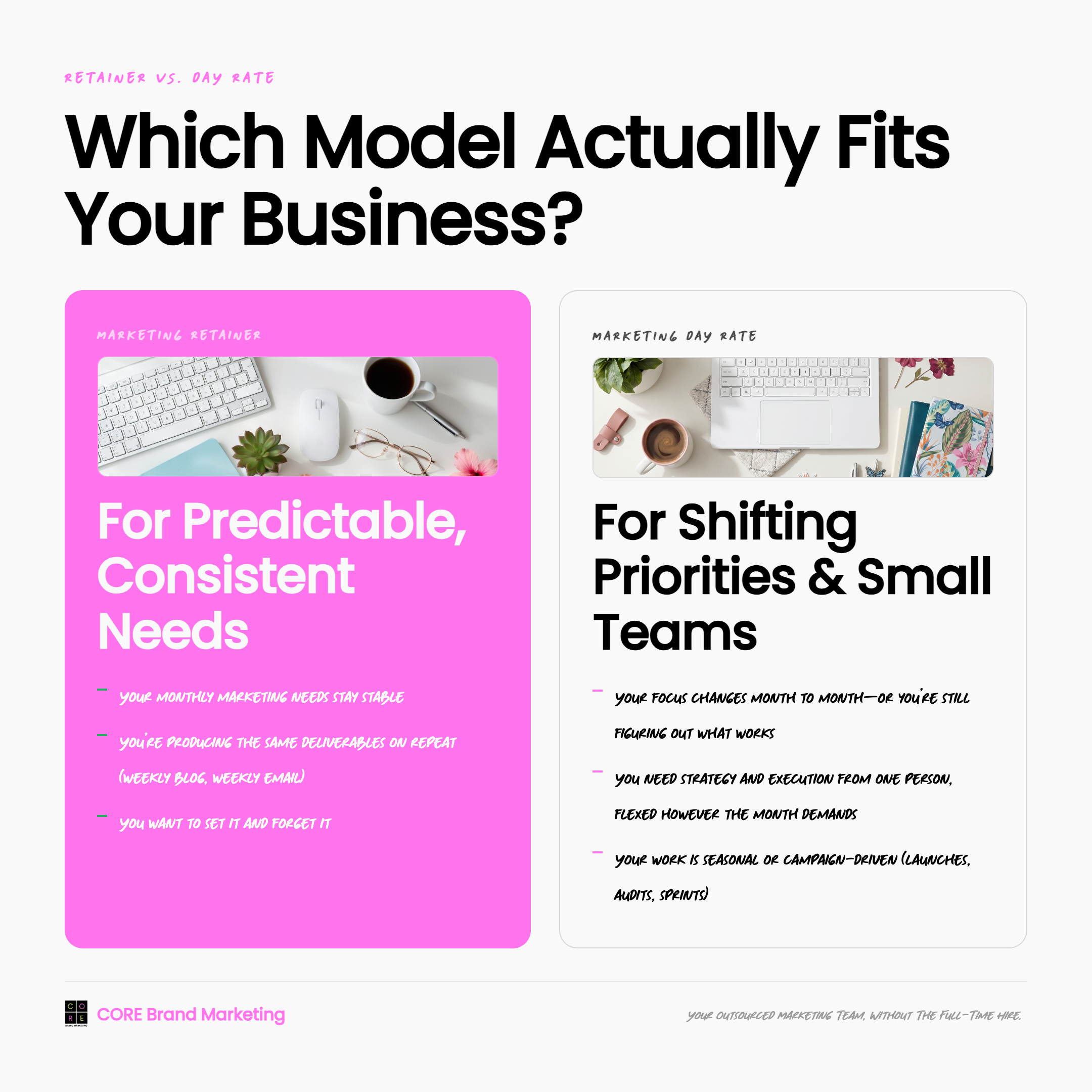
- You have stable, predictable monthly marketing needs
- You produce consistent volume of the same deliverables (e.g., a weekly blog and weekly email)
- You want to set marketing on autopilot and stop thinking about it
- Your budget is comfortably above $3,000/month
- You’re committed to a 6–12 month relationship with one provider
Choose a marketing day rate if:
- Your priorities shift month to month
- You’re a small business or solo founder still figuring out what’s working
- You want a lower-commitment way to test working with someone
- Your needs are seasonal or campaign-based (launches, audits, sprints)
- Budget flexibility matters — you want to scale up or down without renegotiating
- You want strategy and execution from the same person, used however this month requires
For most small businesses I work with, the day rate model wins on every dimension that actually matters — and that’s true even when their monthly investment lands in the same range as a traditional retainer. The difference is how the dollars get used. According to the U.S. Small Business Administration, small businesses spend an average of 7–8% of revenue on marketing — and the businesses that get the most out of that spend are the ones whose marketing budget can flex with their actual needs.
A Third Option Most Small Businesses Don’t Know About
There’s a third path that takes the best of both models and leaves the worst behind. It’s what I built CORE Days around.
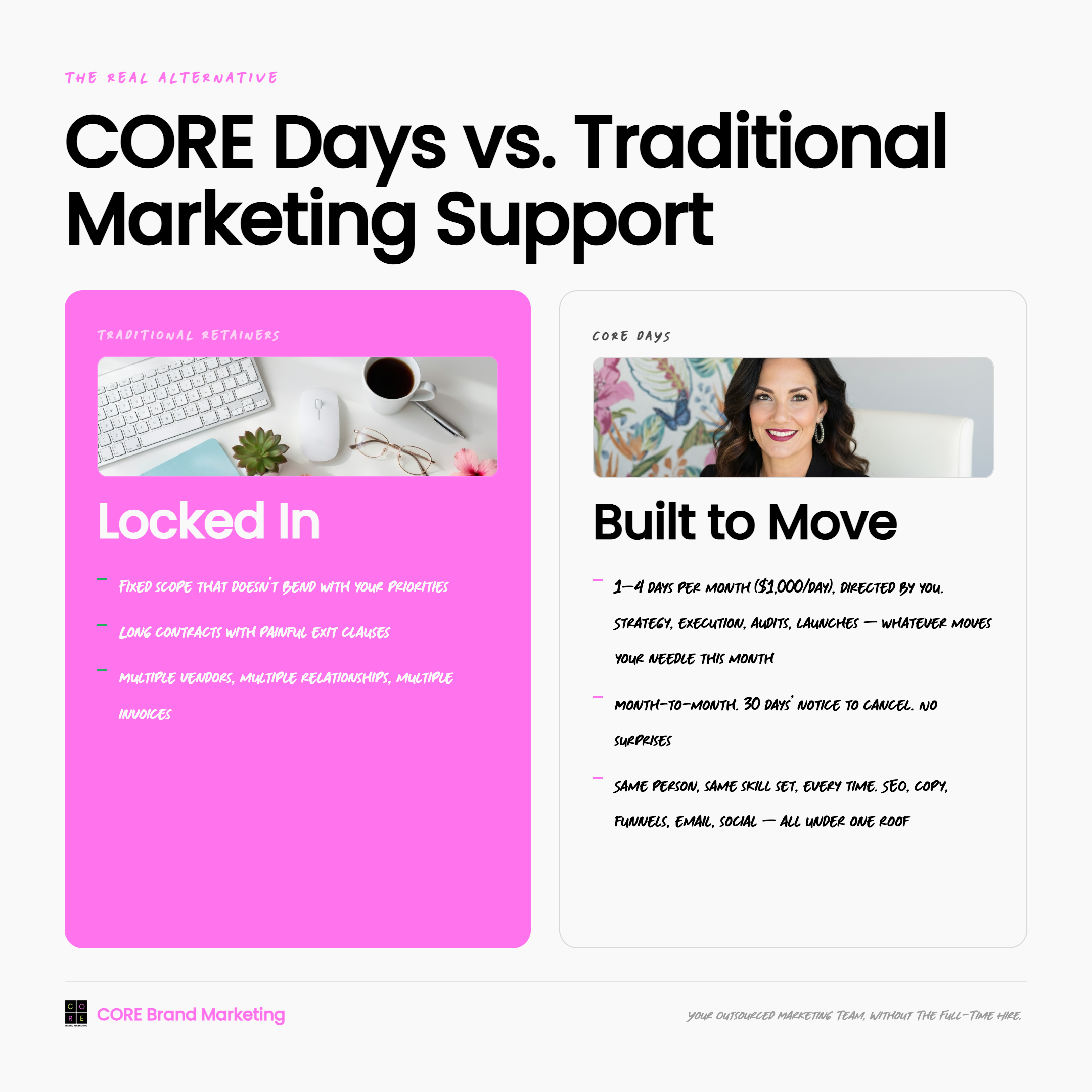
Here’s how CORE Days works: You buy 1 to 4 days of focused marketing work per month at $1,000 per day. Each day is 5 hours of expert marketing work, done by me, on your business. You direct where the time goes — strategy, execution, audits, funnel work, content, email, social, a launch, a website tune-up. Whatever moves your needle this month.
What it solves:
- No locked-in scope. Priorities shift, the days bend with you.
- No long contract. Month-to-month with 30 days’ notice to cancel.
- Same skill set every day. SEO, copy, funnels, email, social — all under one roof.
- Scales with you. 1 day a month for solopreneurs. 4 days a month for businesses ready to scale.
It’s the closest thing to having a part-time marketing partner — without the part-time-CMO price tag, the rigid retainer scope, or the long contract.
Frequently Asked Questions
Is a marketing retainer cheaper than a day rate?
Not necessarily. Most quality marketing retainers run $2,500–$5,000+ per month for small businesses. A day-rate model at $1,000 per day gives you the same monthly investment range with significantly more flexibility — you choose 1, 2, 3, or 4 days a month based on what you actually need.
How do I know if a day rate or retainer is better for my small business?
Look at how stable your marketing priorities are month to month. If you produce the same deliverables on a fixed schedule, a retainer makes sense. If your priorities shift — a launch this month, a website fix next month, an SEO sprint after that — a day rate model bends with you and prevents wasted scope.
What’s a fair day rate for marketing services?
Day rates for experienced marketing professionals typically range from $750 to $2,500 per day, depending on experience, deliverables included, and the type of work. The lower end usually reflects execution-only work, while the higher end includes strategy, full-funnel marketing, and senior-level guidance.
Can I switch from a retainer to a day rate?
Yes — most month-to-month day-rate arrangements allow you to start with a single day to test the fit, then scale up. If you’re currently on a retainer with another provider, check your contract terms for cancellation requirements before making the switch.
What happens if I don’t use all my marketing days in a month?
This depends on the provider. Some allow rollover; most don’t because the value of focused, scheduled time evaporates if it stacks. The structure works best when each month resets and you plan fresh based on what your business needs next.
The Bottom Line
The marketing retainer vs day rate debate doesn’t have one winning answer — it has your winning answer. If your business has stable, repeatable marketing needs and you want predictability, a traditional retainer can work beautifully. If your priorities shift, your needs vary, or you want a lower-risk way to start working with a marketing partner, a day rate is almost certainly the better fit.
For small businesses still figuring out the right rhythm, I’d start with a single CORE Day, see what’s possible in 5 focused hours, and scale from there. No long contract. No locked-in scope. Just real marketing help, booked by the day.
Ready to see what a CORE Day could do for your business? Apply to work with us →




0 Comments