
If you’ve been posting consistently, showing up on social media, and still watching your reach drop — you’re not imagining it. Something fundamental changed. And it’s not your content. It’s the platforms themselves.
The question every small business owner should be asking right now is: what is interest media — and why does it matter more than anything else in your 2026 marketing strategy?
Here’s the short version: the social media you built your business on doesn’t work the way it used to. The platforms have quietly shifted from showing your content to your followers to showing your content to people who are interested in your topic — whether they follow you or not. That’s interest media. And once you understand it, everything about how you create content, choose platforms, and measure success changes.
Let’s break it down.
Table of Contents
What Is Interest Media and Why Does It Matter?
Interest media is the term used to describe the way social platforms now distribute content. Instead of prioritizing your existing followers in the feed, platforms like Instagram, TikTok, Facebook, LinkedIn, YouTube, and Pinterest now use algorithm-driven interest signals to push content to people based on what they engage with — not who they follow.
Think about your own behavior for a second. When was the last time you scrolled your Instagram feed and saw mostly posts from accounts you follow? Probably a while ago. Instead, you’re seeing Reels from creators you’ve never heard of, suggested posts about topics you recently searched, and content that aligns with things you’ve liked, saved, or watched in the past.
That’s interest media at work.
For small business owners, this is actually a massive opportunity — if you know how to use it. It means you no longer need 10,000 followers to get visibility. A well-crafted piece of content on the right topic can reach thousands of people who are already interested in what you offer, even if they’ve never heard of your brand before.
But here’s the flip side: if you’re still creating content designed to talk to your existing audience instead of content designed to attract new people through topic relevance, your reach is going to keep shrinking. The algorithm isn’t broken. The rules just changed.
How Social Media Became Interest Media
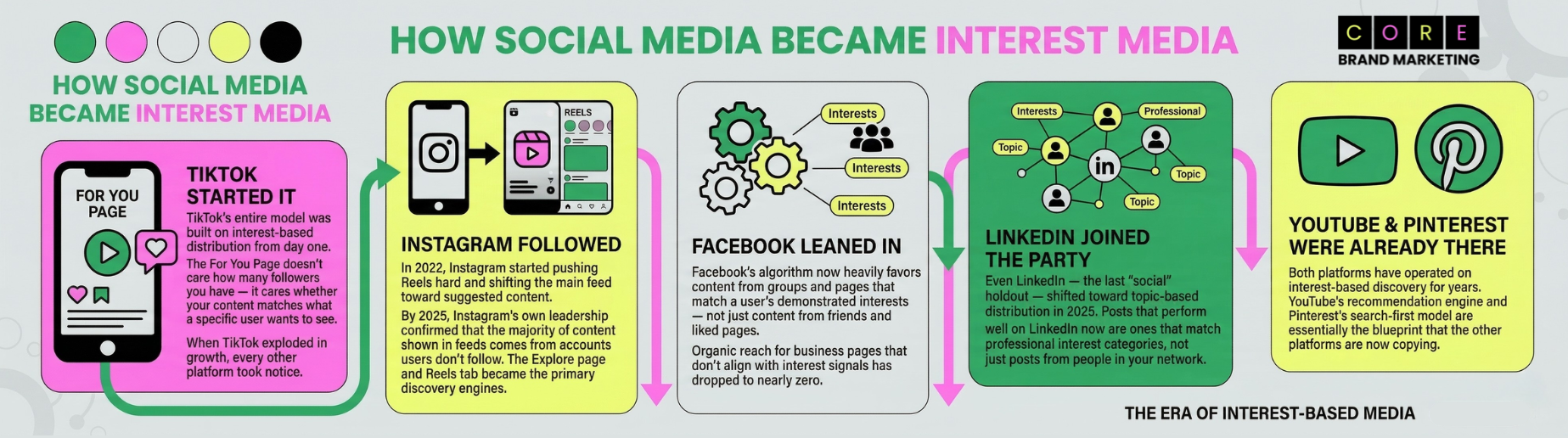
This shift didn’t happen overnight, but it accelerated dramatically between 2023 and 2026. Here’s the timeline:
TikTok started it. TikTok’s entire model was built on interest-based distribution from day one. The For You Page doesn’t care how many followers you have — it cares whether your content matches what a specific user wants to see. When TikTok exploded in growth, every other platform took notice.
Instagram followed. In 2022, Instagram started pushing Reels hard and shifting the main feed toward suggested content. By 2025, Instagram’s own leadership confirmed that the majority of content shown in feeds comes from accounts users don’t follow. The Explore page and Reels tab became the primary discovery engines.
Facebook leaned in. Facebook’s algorithm now heavily favors content from groups and pages that match a user’s demonstrated interests — not just content from friends and liked pages. Organic reach for business pages that don’t align with interest signals has dropped to nearly zero.
LinkedIn joined the party. Even LinkedIn — the last “social” holdout — shifted toward topic-based distribution in 2025. Posts that perform well on LinkedIn now are ones that match professional interest categories, not just posts from people in your network.
YouTube and Pinterest were already there. Both platforms have operated on interest-based discovery for years. YouTube’s recommendation engine and Pinterest’s search-first model are essentially the blueprint that the other platforms are now copying.
The result? Every major platform now functions more like a search engine for interests than a social network for connections. And that changes everything about how you should be creating content.
What This Means for Small Business Owners
If you’re a small business owner who’s been grinding away at social media — posting daily, trying to grow followers, stressing over engagement rates — this shift might actually come as a relief. Because the old model was stacked against you. Growing a following from scratch is brutal, time-consuming, and frankly, a game that favors people who are already big.
Interest media levels the playing field.
Here’s what changes in practice:
Followers matter less. Topics matter more. Your content strategy should start with the topics your ideal customer is already searching for and engaging with — not with what your current followers want to see. Those two things might overlap, but they’re not the same.
Discoverability is the new metric. Instead of obsessing over likes and comments from your existing audience, focus on reach, shares, saves, and watch time. These are the signals that tell the algorithm your content is relevant to a broader interest group.
Platform-native content wins. Cross-posting the same graphic to Instagram, Facebook, LinkedIn, and Pinterest doesn’t work anymore. Each platform’s algorithm rewards content that’s built for that specific platform’s format and behavior patterns. A vertical video with captions and a hook in the first two seconds performs on TikTok and Reels. A text-heavy, opinion-driven post performs on LinkedIn. A keyword-rich pin with a clean vertical image performs on Pinterest. Same business, same message — completely different execution.
You don’t have to be on every platform. This is the part that overwhelmed business owners need to hear: interest media actually makes it easier to be strategic about where you show up. Instead of spreading yourself thin across six platforms, you can focus on the one or two where your ideal customer’s interests are most active — and go deep there.
Faceless content has never been more powerful. Here’s something I feel strongly about, and it’s one of the reasons I built CORE Brand Marketing the way I did: you don’t have to be on camera to win at interest media. The algorithm doesn’t care about your face. It cares about your topic. Voiceover Reels, text-based carousels, educational pins, long-form blog content that drives search traffic — all of these are faceless formats that perform incredibly well in an interest-based system.
The 5 Interest Media Signals Every Platform Rewards
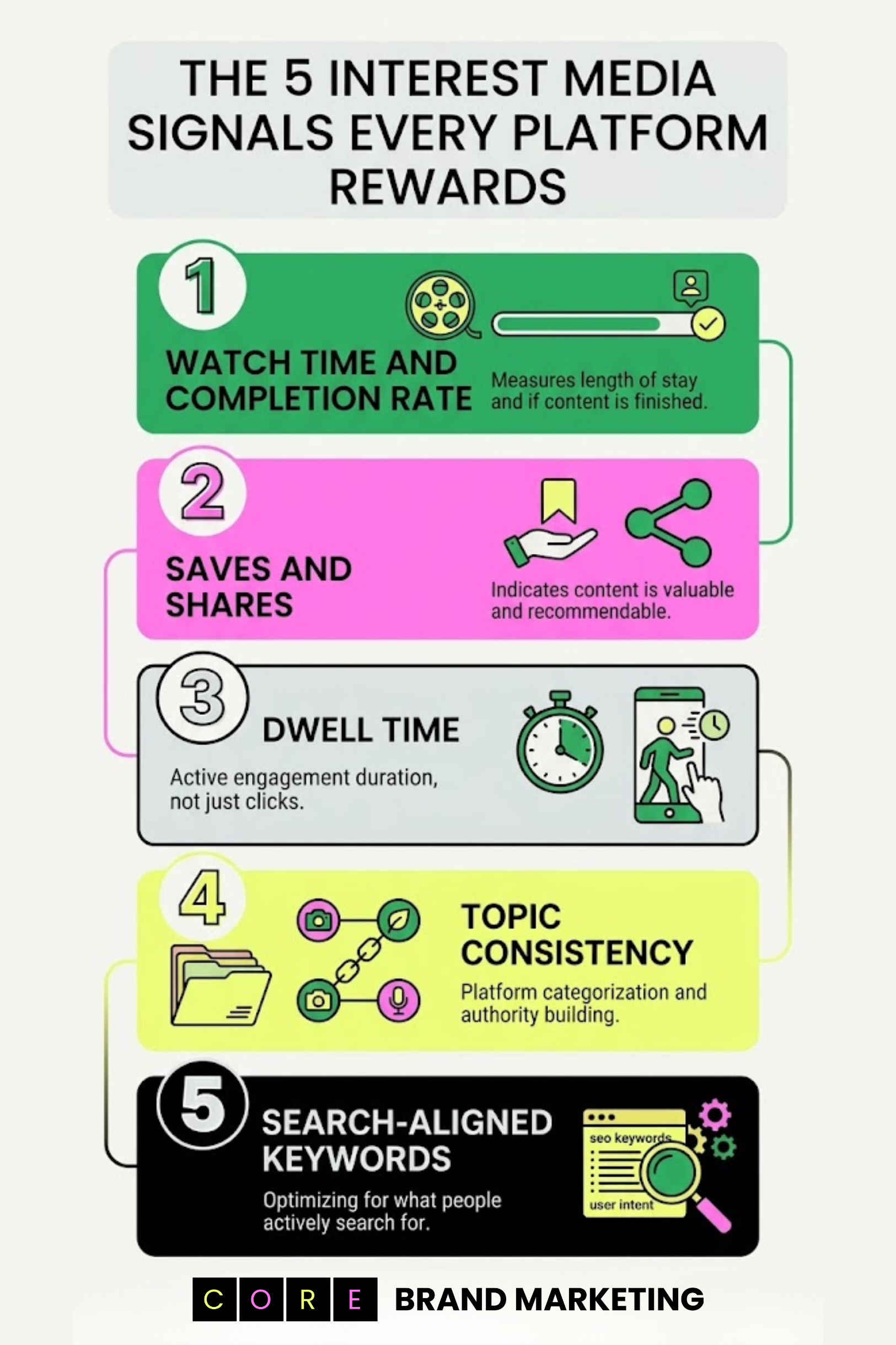
Understanding what is interest media is one thing. Knowing how to actually optimize for it is another. Across every major platform in 2026, these are the five signals that determine whether your content gets pushed to a wider interest-based audience — or dies in the feed:
- Watch time and completion rate. If someone watches your video all the way through, the algorithm reads that as a strong interest signal. Short, punchy content that holds attention outperforms long, rambling posts every time.
- Saves and shares. These are the gold-standard engagement signals in 2026. A save tells the platform “this content is valuable enough to come back to.” A share tells the platform “this content is valuable enough to send to someone else.” Both trigger wider distribution.
- Dwell time. How long someone spends reading your caption, looking at your carousel, or sitting on your post matters. Platforms track this — even if the user doesn’t like or comment.
- Topic consistency. The algorithm categorizes your account by topic. If you post about marketing strategy on Monday, your dog on Tuesday, and a recipe on Wednesday, the algorithm doesn’t know who to show your content to. Consistent topic focus helps the algorithm match you to the right interest groups.
- Search-aligned keywords. This is new for platforms that used to be purely social. Instagram, TikTok, YouTube, and even LinkedIn now function partly as search engines. Using relevant keywords in your captions, alt text, and hashtags helps the algorithm categorize your content and surface it to people searching for that topic.
How to Adapt Your Content Strategy for Interest Media
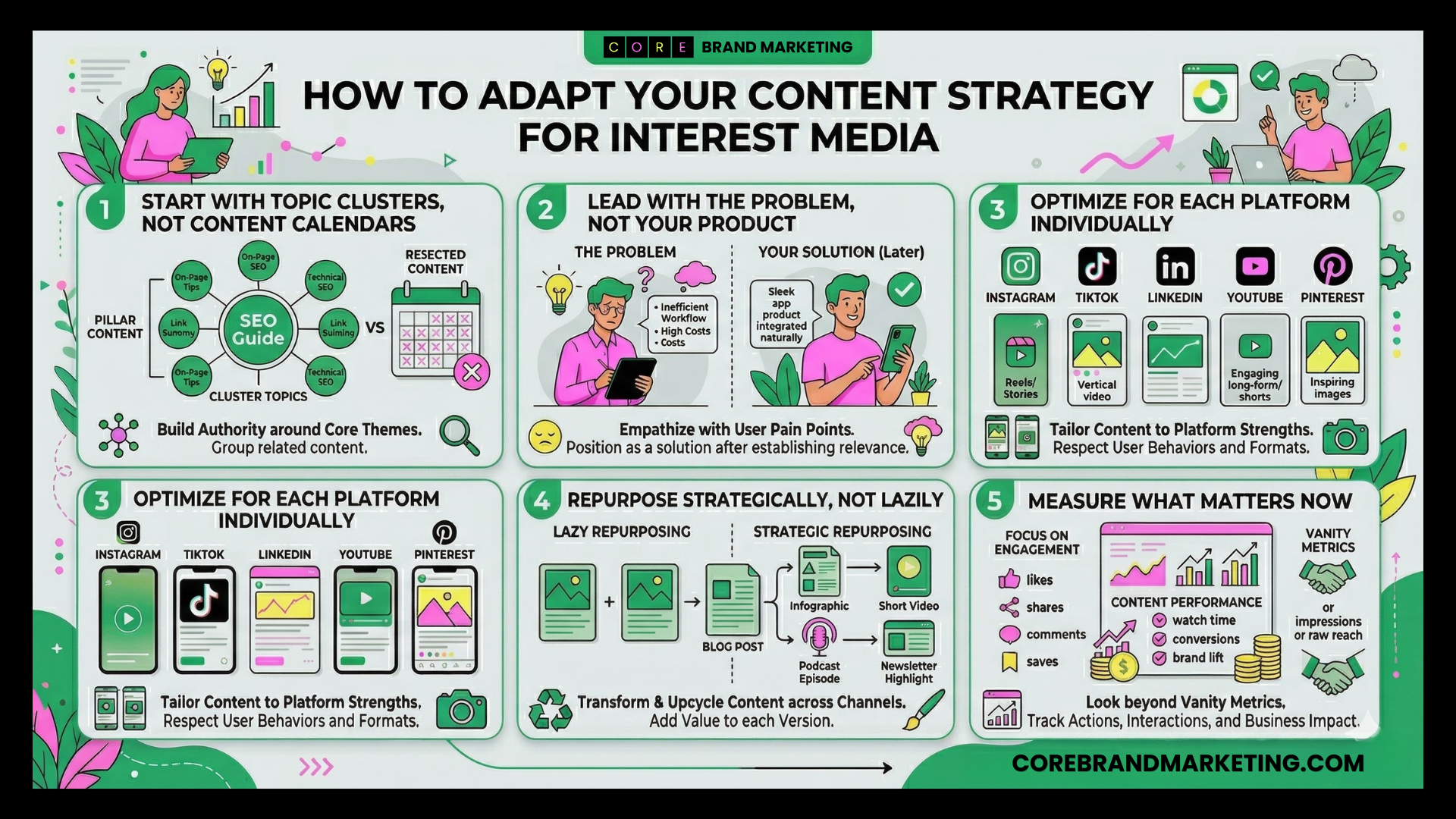
Knowing the theory is great. But what do you actually do differently starting this week? Here’s a practical framework:
- Start with topic clusters, not content calendars. Instead of filling a calendar with random post ideas, identify three to five core topics that your ideal customer cares about. Every piece of content you create should ladder up to one of those topics. This trains the algorithm to categorize your account correctly and push your content to the right people.
- Lead with the problem, not your product. Interest media rewards content that helps people, not content that sells to them. Your best-performing content will be the posts that answer a question, solve a problem, or teach something useful — because that’s what people are searching for and engaging with.
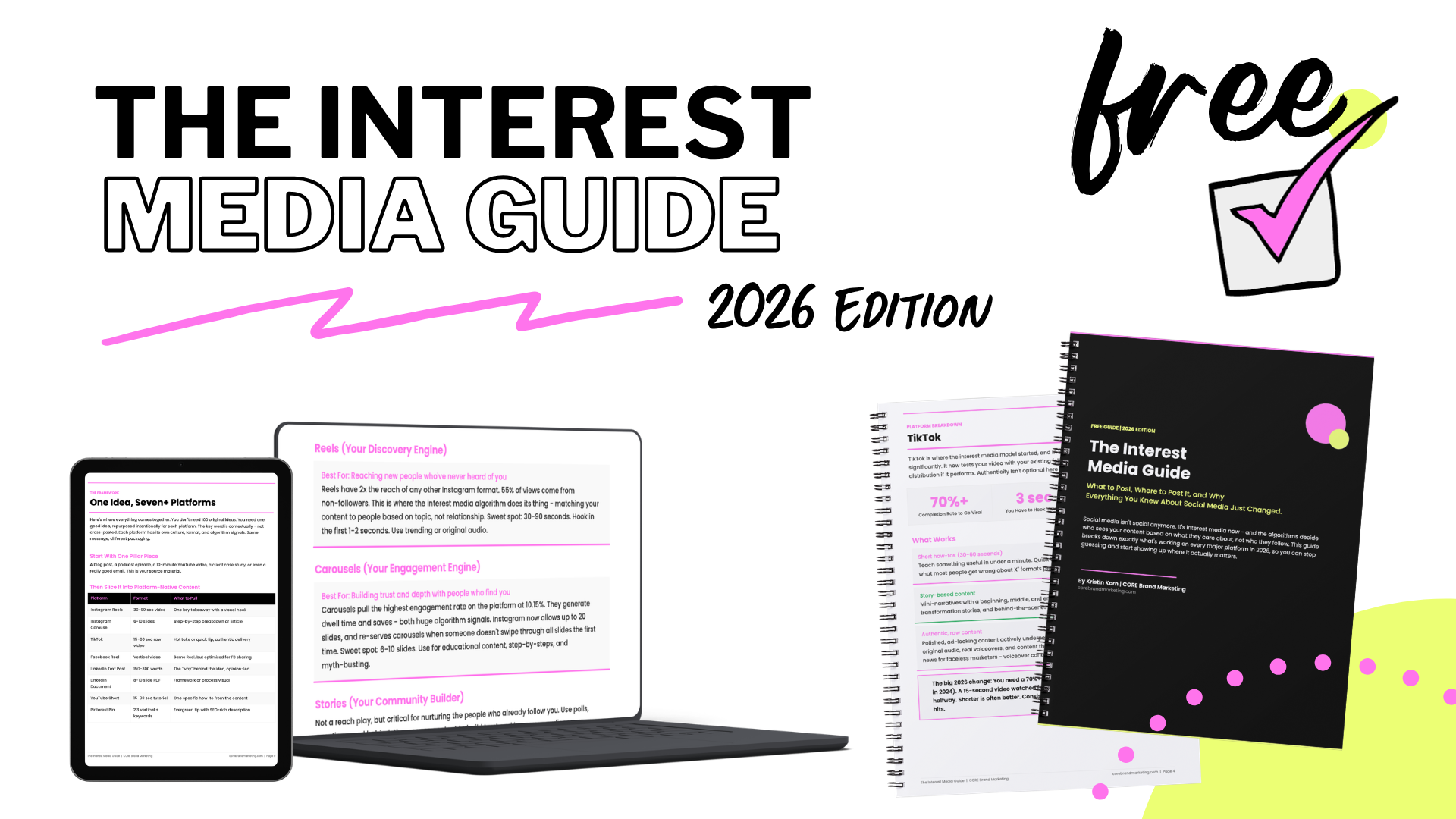
- Optimize for each platform individually. I know this sounds like more work, but it’s actually less — because you’re not trying to be everywhere anymore. Pick your primary platform, learn its specific algorithm signals, and create content that’s native to that format. If you want a breakdown of exactly what’s working on each platform right now, that’s exactly what our free Interest Media Guide covers.
- Repurpose strategically, not lazily. You can take one blog post or one core idea and turn it into multiple pieces of content across platforms. But the key word is adapt. A blog post becomes a carousel on Instagram, a text post on LinkedIn, a voiceover Reel on TikTok, and a keyword-rich pin on Pinterest. Same core idea, platform-native execution every time.
- Measure what matters now. Stop tracking vanity metrics like follower count and likes. Start tracking reach (especially to non-followers), saves, shares, watch time, and website clicks. These are the metrics that tell you whether your content is actually being discovered by new people through interest signals.
If your marketing keeps falling to the bottom of the to-do list and you want a partner who handles all of this — the strategy, the content creation, the platform-specific optimization — that’s exactly what outsourced marketing looks like in practice.
4 Common Mistakes Small Businesses Make With Interest Media
Understanding what is interest media doesn’t automatically mean you’ll nail the execution. Here are the most common mistakes I see small business owners make when trying to adapt:
- Posting the same content everywhere. Cross-posting a single graphic to every platform is the fastest way to get penalized by interest-based algorithms. Each platform has different content formats, different user behaviors, and different ranking signals. What works on Pinterest will flop on TikTok, and what performs on LinkedIn will get buried on Instagram.
- Chasing trends instead of building topical authority. Trending audio and viral formats can give you a temporary spike, but the algorithm rewards consistent topical relevance over time. If you jump from trend to trend without a clear content focus, the algorithm won’t know who to show your content to.
- Ignoring SEO on social platforms. This is a big one. Most small business owners still think of SEO as a Google-only strategy. But Instagram, TikTok, YouTube, and Pinterest all have search functions now — and they’re being used heavily by consumers in 2026. If you’re not using keywords in your captions, titles, and descriptions, you’re invisible to people actively searching for what you offer.
- Giving up too soon. Interest media rewards consistency. The algorithm needs data to categorize your account and start matching you with the right audience. That takes time — usually four to eight weeks of consistent, topic-focused posting before you start seeing meaningful traction. Most business owners quit at week two.
Your Next Step: Stop Guessing, Start Showing Up Strategically
The shift from social media to interest media isn’t coming — it’s already here. And the business owners who understand it are getting their content in front of the right people without needing a massive following, a huge ad budget, or a camera in their face every day.
You don’t have to overhaul everything overnight. But you do need to understand the new rules — and that’s exactly why I put together the Interest Media Guide. It’s free, it covers what’s working on every major platform in 2026, and it gives you a practical framework for showing up where your ideal customers are already looking.
Download the free Interest Media Guide here and start making your content work with the algorithm instead of against it.
Frequently Asked Questions
What is interest media in simple terms?
Interest media is the way social platforms now distribute content based on what users are interested in — rather than who they follow. Instead of showing your posts to your followers, platforms like Instagram, TikTok, and LinkedIn push content to people who engage with similar topics. It means your content can reach people who’ve never heard of your brand, as long as it aligns with what they care about.
Is interest media the same as social media?
Not exactly. Social media was originally built around personal connections — you followed friends, family, and brands you liked, and saw their content in your feed. Interest media describes the current model where algorithms prioritize topic relevance and engagement signals over personal connections. The platforms are the same, but the way content gets distributed has fundamentally changed.
How do I optimize my content for interest media as a small business?
Focus on three things: pick consistent content topics that align with what your ideal customer searches for, create content that’s native to each platform’s preferred format, and track discovery metrics like reach to non-followers, saves, and shares instead of just likes and comments. Our free Interest Media Guide breaks down exactly what each platform rewards in 2026.
Do I need to be on camera to succeed with interest media?
No — and that’s one of the best things about this shift. Interest media algorithms care about your topic and your content quality, not whether your face is on screen. Voiceover videos, text-based carousels, blog-driven SEO content, and keyword-rich pins all perform extremely well without ever showing your face. It’s the foundation of what we call faceless marketing.
Which platforms are best for interest media in 2026?
Every major platform now uses interest-based distribution, but the strongest interest media platforms are TikTok, Instagram (especially Reels and Explore), YouTube Shorts, and Pinterest. LinkedIn has also shifted significantly toward topic-based distribution for professional content. The best platform for your business depends on where your ideal customer spends time and what type of content you can create consistently.


0 Comments