

You’ve invested in a beautiful website. Your services page is solid. Your contact form works. And yet — when someone Googles a question your business could answer, your competitor shows up instead of you.
Sound familiar? Here’s the hard truth: if your website doesn’t have a blog or content section, there is literally no way for you to rank for the long-tail, informational searches that drive organic traffic. And your competitors who do have a blog? They’re quietly scooping up every one of those clicks while you stay invisible.
This is the single biggest SEO gap we see when we run marketing audits — and the good news is, it’s completely fixable.
Table of Contents
How Your Competitors Outrank You Without You Even Realizing It
Here’s what’s actually happening behind the scenes. When a potential customer types something like “how to choose a reliable [your service]” or “what to look for in a [your industry] provider,” Google scans the internet for the most helpful, relevant content to show them.
If your competitor has a blog post that answers that exact question — and you have nothing — guess who wins? Every single time.
It’s not that their business is better than yours. It’s that they gave Google something to work with, and you didn’t.
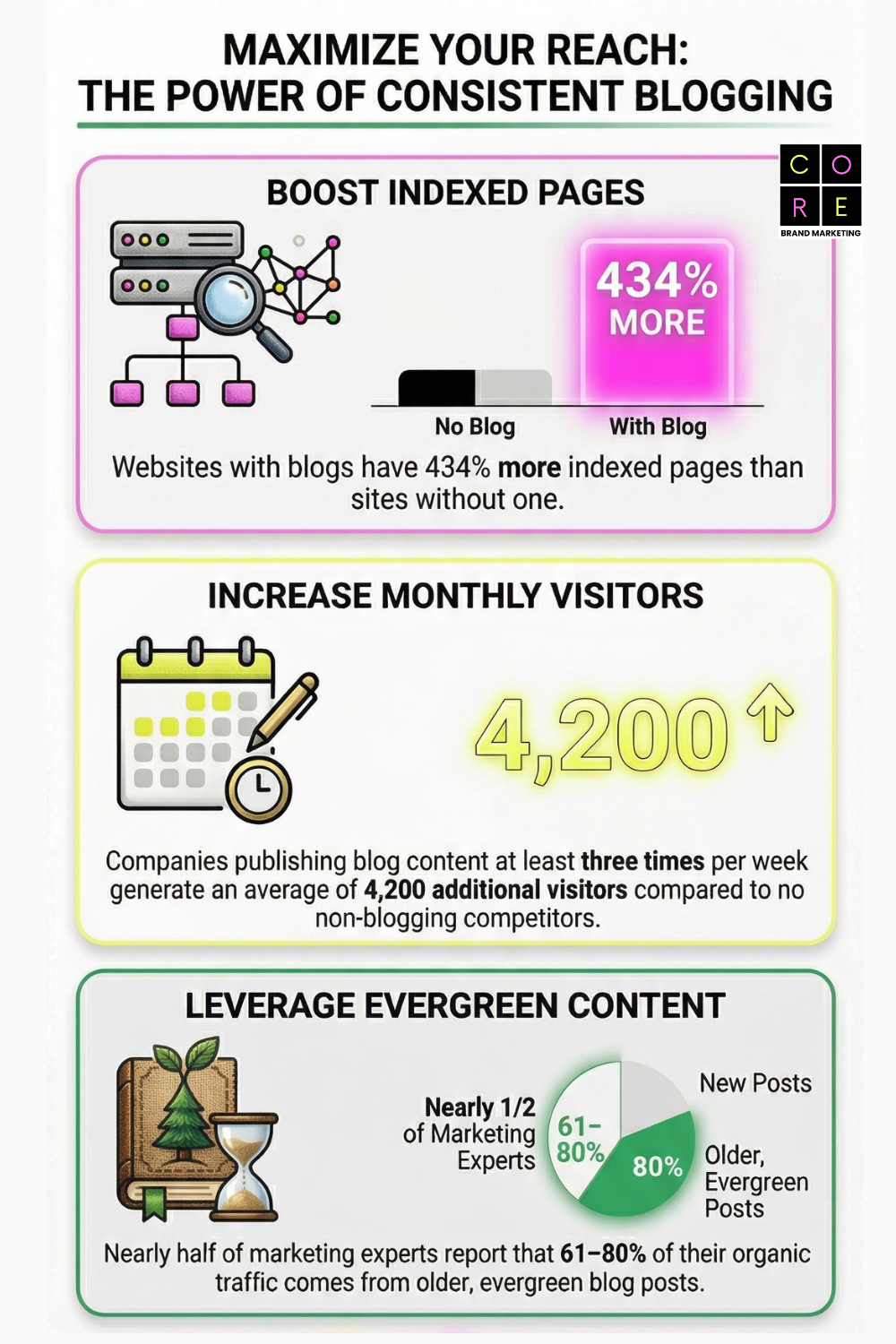
Consider these numbers:
- Websites with blogs have 434% more indexed pages than sites without one
- Companies publishing blog content at least three times per week generate an average of 4,200 additional monthly visitors compared to non-blogging competitors
- Nearly half of marketing experts report that 61–80% of their organic traffic comes from older, evergreen blog posts
That last stat is worth reading again. The blog posts your competitor wrote six months ago are still working for them today — bringing in traffic, building trust, and generating leads on autopilot. That’s the power of evergreen content.
Why Your Website Needs a Blog to Compete in Search
Let’s break this down simply. Your website’s service pages and homepage target branded and transactional keywords — things like your business name, “hire a [service provider] near me,” or “[your service] pricing.”
But those searches only capture people who already know what they want and who you are. That’s a tiny fraction of your potential audience.
The vast majority of searches are informational — people researching, comparing, learning. Things like:
- “What does an outsourced marketing team actually do?”
- “How often should a small business post on social media?”
- “Is SEO worth it for a local business?”
Without blog content targeting these questions, you’re invisible for the entire research phase of the buyer’s journey. And by the time that person is ready to buy, they’ve already built trust with the competitor whose blog helped them along the way.
A blog is how you show up early, build authority, and stay top-of-mind — long before someone is ready to fill out a contact form.
The Real Cost of Not Having a Blog on Your Website
Let’s talk about what this gap is actually costing you, because it’s more than just “missed traffic.”
You’re paying more for every lead. Without organic content bringing people in, you’re relying entirely on paid ads, social media hustle, or word-of-mouth. Every single lead costs you time or money — and when you stop spending, the leads stop too.
You’re handing authority to competitors. When your competitor’s blog shows up for industry questions, Google starts to see them as the expert — not you. Over time, this compounds. They rank higher for more terms, earn more backlinks naturally, and become the go-to resource in your space.
You’re missing compound growth. A single well-written blog post can generate traffic for years. That’s not an exaggeration. Unlike a social media post that disappears in 24 hours or an ad that stops the moment your budget runs out, blog content compounds over time. One post becomes a long-term asset.
You’re invisible to people already looking for you. Not you specifically — but someone exactly like you. They’re searching for answers you could give, problems you could solve, and services you could provide. But without content, you simply don’t exist in their search results.
How to Fix This SEO Gap: A Simple Blog Strategy That Works
Here’s where it gets encouraging. You don’t need to publish five posts a week or become a full-time content creator. A strategic, consistent blog — even two to four posts per month — can make a dramatic difference.
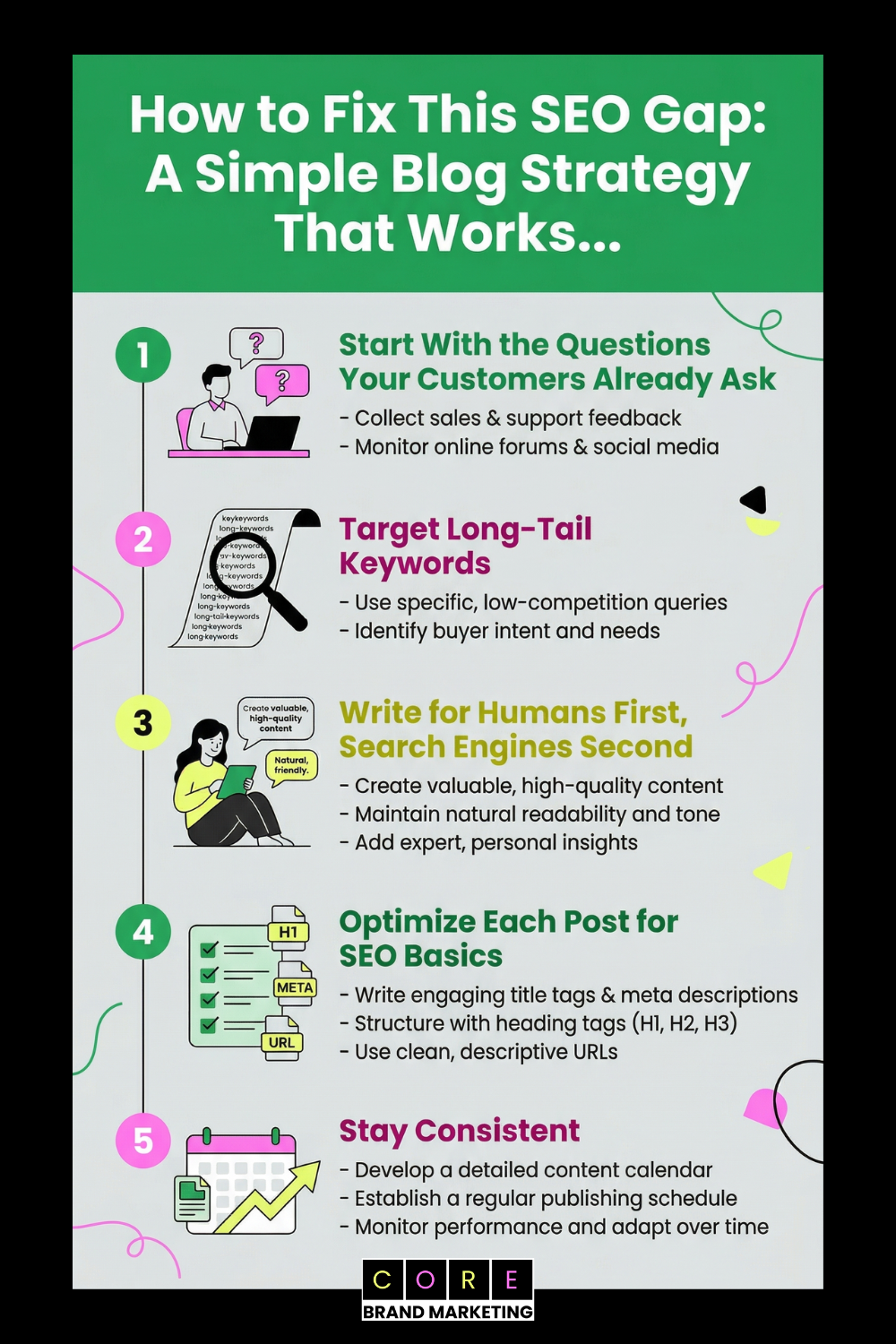
Here’s how to approach it:
1. Start With the Questions Your Customers Already Ask
Think about the questions you hear in consultations, emails, and DMs every week. Those are your first blog topics. If real people are asking, other people are Googling the same thing.
2. Target Long-Tail Keywords
Instead of trying to rank for broad, competitive terms like “marketing” or “home builder,” target specific phrases like “how to choose an outsourced marketing team for a small business” or “what to expect during a custom home build.” These longer phrases have less competition and attract people with real intent.
3. Write for Humans First, Search Engines Second
Google’s algorithm in 2026 is smarter than ever. It rewards content that genuinely helps people — not keyword-stuffed filler. Write the way you’d explain something to a client sitting across from you. Be clear, be helpful, and be real.
4. Optimize Each Post for SEO Basics
Every post should have:
- A clear focus keyword used naturally throughout
- An SEO title and meta description that make people want to click
- Internal links to your service pages (this helps Google understand your site structure)
- At least one external link to a credible source
- Images with descriptive alt text
- Subheadings that break up the content and include related keywords
5. Stay Consistent
The businesses that win with SEO blogging aren’t the ones who write one post and wait for magic. They’re the ones who show up consistently — month after month — building a library of helpful content that works around the clock.
You Don’t Have to Do This Alone
If you’re reading this and thinking, “I know I need a blog, but when am I supposed to find the time to write one?” — you’re not alone. That’s one of the most common things we hear from the business owners we work with.
Marketing keeps falling to the bottom of the to-do list. You’re wearing too many hats. And the idea of adding “write SEO blog posts” to your plate feels like one more thing you don’t have bandwidth for.
That’s exactly why we offer SEO-driven content as part of our done-for-you marketing services. We handle the keyword research, the writing, the optimization — all of it — so your website starts ranking for the searches that matter, without you having to write a single word.
Your competitors have a blog. It’s time you did too.
Want to see exactly where your website stands? Our CORE Marketing Audit scores your SEO and social media presence out of 100 and shows you every gap — including whether your content strategy is helping or hurting your visibility. It’s the fastest way to find out what’s working, what’s not, and what to fix first.
Frequently Asked Questions
Q: Why does my website need a blog if I already have service pages?
A: Service pages target people who already know what they need. A blog captures the much larger audience of people researching, comparing, and learning — building trust with them before they’re ready to buy. Without blog content, you’re invisible during the entire research phase of the buyer’s journey.
Q: How often should a small business publish blog posts for SEO?
A: Consistency matters more than volume. Two to four well-optimized posts per month is a strong starting point for most small businesses. The key is that each post targets a specific keyword, answers a real question, and is written to genuinely help your audience.
Q: How long does it take to see SEO results from blogging?
A: Most businesses start seeing measurable organic traffic growth within three to six months of consistent publishing. Some posts gain traction faster than others, but the real power is in the compound effect — each new post adds to your site’s authority and keyword coverage over time.
Q: Can I just use social media instead of a blog?
A: Social media is great for engagement and brand awareness, but it doesn’t help you rank in Google. A social post has a lifespan of hours to days. A blog post can drive traffic for years. The smartest strategy uses both — but if you had to choose one for long-term lead generation, the blog wins every time.
Q: What if I don’t have time to write blog posts myself?
A: You don’t have to. An outsourced marketing partner like CORE Brand Marketing can handle your entire blog strategy — from keyword research to writing to publishing — so your site starts ranking without adding another task to your plate. That’s kind of our whole thing.

0 Comments